It seems like an eon since last a Bass Cadet article was posted. Finally it’s time to rectify matters with an interesting addition. I gave away a few clues in my previous article, savvy retro heads should have figured it out long before this post went up.
Sierra On-Line were one of my fave game development houses back in the 80’s with their strong line-up of adventure titles. A noteworthy developer, particularly on the PC. They had a knack for quality games and amazing packaging with killer cover art. Probably the end result of, a genuinely inspired passion for what gaming, was truly all about.
However, Sierra were not just a developer but also a publisher that established ties with one of their counterparts in Japan. This was none other than the equally proficient – Game Arts. Famous for releasing hit games such as Thexder, Silpheed, Zeliard and later on the Lunar and Grandia series of rpg’s.
Game Arts started out developing for home computer platforms such as the MSX and NEC PC-8801. Both of which were hugely popular in Japan. Sierra On-Line ported and published Game Art’s earlier titles over to the west, with great success.
While Thexder remains a firm favourite of mine, and still enjoy to play it periodically. I have fond memories of Silpheed for a reason. This game came packed in with my very first sound card – Creative Labs’ Game Blaster. Finally I could enjoy arcade-quality FM tunes on my home PC and Silpheed would be my first foray.
I’ll be honest, Silpheed is not a particularly great game – it’s not terrible by any stretch either. Technically it’s impressive for it’s time, but rather bland. None the less, control is great and a space opera ambiance is conveyed rather competently. The music plays a big part in this, managing to cover cheerful, heroic and melancholic melodies. As the player, one does get a sense of partaking in an interstellar dog fighting scenario.
Silpheed’s BGM is composed by Hibiki Godai which just happens to be an alias. The real artist’s name is Kohei Ikeda for the sound team known as Mecano Associates. Above is the soundtrack of the original version of the game when it debuted on the NEC PC-8801 on the 5th of December, 1986.
Last month I was able to reveal a little about the game project that I’ve been working on. Shares, retweets, favourites, +1’s and feedback via messages and email from many of you has been both positive and very encouraging – thank you!
It seems that the ‘Project MSG’ logo made a strong impact. The response that I received, while not entirely unexpected, was rather more enthusiastic than anticipated. While I do concur that it’s a cool looking logo. And as the creator of this logo I would like to add that I do so in a humble and non-boisterous manner. What matters is that you love it!
I should consider taking t-shirt orders 🙂
The logo has managed to convey and stir up strong nostalgic feelings of8-bit & 16-bit gaming memories for you lot. As if the mid-80’s or even early 90’s were no longer some forgotten bygone era. I have no intention in ruining those feelings and you can all rest assured that the official logo will still retain this flavour.
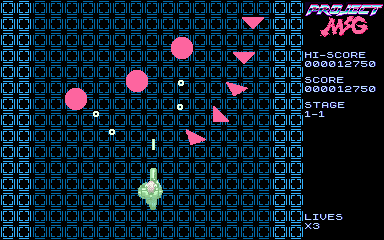
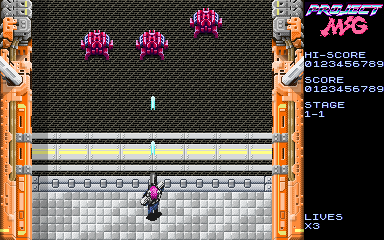
Fortunately, you didn’t just like the logo. There was a single screenshot of ‘stage 1-1’ of the game which managed to attain significant attention. Plus a fair amount in the twittersphere. Detailed pixel art graphics are gladly still welcome among retro game fans. This singular shot only gives a small glimpse of the game, but it’s enough to give a basic idea of the styling and gameplay.
Defining this project becomes easier as work progresses. While the initial brief described it as 2D shooting game with a cyberpunk theme. This is still true for the project today. However, newer aspects start to surface that were faintly observed in the initial stages of development. Comparatively to, an alter ego of some kind, quietly hiding within the shadows of the dominant personality. Only to make itself known at a later date.
Perhaps it all boils down to the aesthetic choices. The clashing of pixel art and FM-synth generated music, while a natural fit gives out a far more raw electronic feel. Due to modern development techniques and increased processing power, we have become accustomed to games that are incredibly slick and shiny. Nothing wrong with this intrinsically. After all, I’m all for high production values and polish in the creation of video games. It’s just that this added fidelity often constitutes in a loss of a raw edge.
This rawness is ultimately part of the charm. It’s not just a retro-centric attribute that I’m pointing out here. It’s inherently punk in nature. Sticking out like a sore thumb, provoking the player that it’s nothing like those big-budget, overproduced but somehow sterile games. Project MSG wants to get dirty!
This much delayed post was supposed to go up end of last month. Apologies for arriving late to the party but there were some business matters that required my attention. Now that I have more time available, blog updates will gradually normalize.
In this article I will focus exclusively on early development work done on Project MSG. Anyone following this blog will already be aware that this project is a retro-style shooting game. Consisting of a cyberpunk theme and a 2D pixel art style with a top-down perspective.While this has intrigued some folks, no work in progress screens have been shown publicly – yet.
Today that will change. The very first shots will be revealed here, exclusively!
While I’ve mentioned this before, it bears repeating: Project MSG is a tentative title. The true name of the game will be revealed sometime before the actual release. Nevertheless I like setting the tone for the game, early on. I took the liberty of designing a logo even though it’s unlikely to find it’s way on to the Alpha.
The logo is shiny, futuristic with an obvious manga-esque influence – just how I like it. Expect the final logo to follow suit.
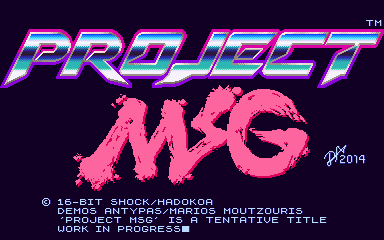
Title screen used for internal development
Next in line is probably one of the most important screens. It’s something that players will not get to see but has been invaluable in developing the game. Making good use of display real estate was always going to be a top priority. Also taking into account the varying display sizes, resolutions and aspect ratios that both PC’s and iOS devices come with – this is a tricky proposition.
To retain an authentic retro/pixel art style it was glaringly obvious that the native resolution we should work with must be low. Ideally the resolution we were initially targeting was 320 x 240 pixels which was pretty much the standard for most 16-bit games. However, due to the prevalence of widescreen displays on the PC front that would cause some issues. As a resolution of 320 x 240 has an aspect ratio of 4:3 and the majority of widescreen displays are 16:9 with a few at 16:10.
In order to counter this problem some experimentation was needed, and an elegant solution to be found. Since the majority, if not all the tiles in the game would be at 16 x 16 pixels I decided that the play area had to conform to this. The integrity of the tiles were to be tested on a variety of display setups from crt monitors through to flat screen monitors and televisions. Last but not least, on iOS devices.
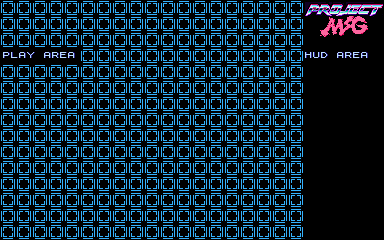
The following screen was created to quickly and efficiently test this out. Our new ideal resolution was also discovered. Almost identical to Capcom’s CP System arcade boards (384 x 224) we went with a native resolution of384 x 240 pixels. Through extensive testing we found that it works very well with a large variety of displays and aspect ratios, while still giving us a little extra space to work with. We reserved this area for the hud.
Testing….testing
After we had that out of the way, it was time to start putting together our prototype. It wasn’t important to make anything fancy, just something that could be done rapidly but still be fun. An important choice that had to be made was whether to take the bullet hell route or go traditional. While I love bullet hell shmups and own a great deal of them, for a debut release I thought it would be best to go as old skool as possible.
The emphasis was now on enemy formations and less about filling the screen with bullets. It was also vital to ensure that the odds were clearly stacked against the player. While a 2-player option was seriously considered, single player was favoured to capture that more desperate hardcore climate. And also to give the player a strong sense of accomplishment once a stage is cleared.
Prototyping the cyborg shooting action!
Certainly, the prototype is not exactly great looking. It may exude some minimalist style but not even close to the desired art direction. I’ve always been a fan of detailed, crisp and colourful graphics. It would only be natural for me to push my pixels in that direction. Considering that our main character is a cyborg – and in turn the setting would take a techno-fetishistic tone.
It didn’t take too long for those tile maps to start taking form. Soon enough the backgrounds for the first stage were done and put in place. Time to animate our hero sprite and populate the screen with some proper enemies.
Shoot you before you shoot me 😛
As you’re reading this, development continues on this project. There will be more updates in the near future to keep you posted on how things are coming along. Till next time!
 16-BIT Shock