Tag Archives: 16-bit

Rediscovering The Sound Blaster

Over the weekend I decided to dig out my old Pentium PC from the storeroom, saving it from permanent obsolescence. Ridding the machine of dust and grime was tiresome and time-consuming. A task that I didn’t confidently believe would be fruitful, as I was unsure whether the various components in the system were in working order.

Slowly but surely I took the computer apart, inspecting the motherboard, power supply unit, cables, video and sound cards, modem, various drives and their relevant controllers etc. On the surface everything seemed fine, just slightly dusty. Thankfully, no nasty capacitor leakage was detected, a scourge on many older computers and other electronic equipment. Even the CMOS battery seemed healthy, but later on it became apparent that it was out of juice and required replacement.
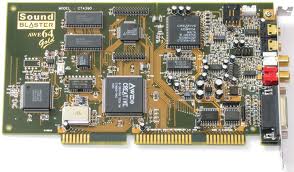
SB16, soundblaster, 16, pro, AWE64, FM, synthsis, Yamaha, retrogaming
Sound Blaster AWE64 still sounds great today

Interestingly enough, with everything in bits and pieces was the opportunity for rediscoveries. Such being the case of the sound card. My trusty old workhorse didn’t just possess any pedestrian audio device…oh no! Instead it would be the Sound Blaster AWE64 from Creative Labs, truly a terrific card with impressive specifications for it’s time. However, it’s real draw is it’s FM Synthesis capabilities which just made me eager to fire it up urgently.

Carefully I attended to piecing together the machine before, finally powering it back on in years. Excited and at the same time worried of prospective faults. Fortunately my fears were soon alleviated, the hum from the power supply sounded as I remembered it. However there was a ‘CMOS Checksum error’ on start up, though that was due to battery depletion which was soon rectified. Apart from some wavy video output, which is somewhat attributed to electromagnetic interference from the power supply. I moved the graphics card to the furthest slot away from the PSU and image quality improved noticeably.

In all likelihood, there is probably a fault with the video card as I don’t recall encountering this issue before. Some shielding could help and am already looking into that. The good news is that everything else is in working order. Once I installed the drivers and tested the Sound Blaster, hearing the sounds generated from this card made all the difference. Finally, all my hard work in getting the Pentium up and running was validated. I now have an authentic and dedicated system which will gradually find it’s way in aiding in my game music compositions.

An awful lot can be said about the differences of working in an emulated environment versus actual hardware. Essentially convenience in contrast to veritable accuracy. One cannot discount the enormous cost factor and usefulness VSTi’s (virtual synthesizer plugins) bring to the table. For some, this may be the only feasible option available to them. And in many ways, music produced with the use of VSTi’s can sound just as good compared to hardware. Not forgetting to mention that, VSTi’s and even trackers have advanced tremendously in offering astoundingly accurate renditions.

Nonetheless, moments spent listening to the Sound Blaster in action is undeniable proof that hardware can trump software. There is an evident richness in the sound that doesn’t quite come through in emulation such as DOSBox or any other applications. Yamaha’s OPL2 & OPL3 FM sound chips were employed in the early range of Sound Blaster cards. Noble attempts at recreating the sounds emanating from these two chips have come close – but still nothing like the real thing.

NEC, PC88, 8801, retro, gaming, computers, japan, maestro, FM, synthesis, Yamaha
The choice PC of the first true FM maestros

It’s been awhile since I’ve last added a Bass Cadet post, and it’s about high time that I did. There’s a particular game soundtrack that I have in mind. I will only give away three clues to give you an idea on what is is. Here they are: Game Arts, Sierra On-Line & NEC PC-8801. Any retro game enthusiast should be able to figure this one out. Till next time 🙂
Project MSG – The Retro-Punk Experience

Last month I was able to reveal a little about the game project that I’ve been working on. Shares, retweets, favourites, +1’s and feedback via messages and email from many of you has been both positive and very encouraging – thank you!

It seems that the ‘Project MSG’ logo made a strong impact. The response that I received, while not entirely unexpected, was rather more enthusiastic than anticipated. While I do concur that it’s a cool looking logo. And as the creator of this logo I would like to add that I do so in a humble and non-boisterous manner. What matters is that you love it!

ProjectMSG_WhiteBackground
I should consider taking t-shirt orders 🙂

The logo has managed to convey and stir up strong nostalgic feelings of 8-bit & 16-bit gaming memories for you lot. As if the mid-80’s or even early 90’s were no longer some forgotten bygone era. I have no intention in ruining those feelings and you can all rest assured that the official logo will still retain this flavour.

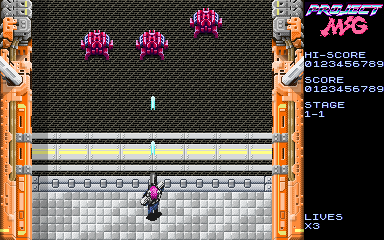
Fortunately, you didn’t just like the logo. There was a single screenshot of ‘stage 1-1’ of the game which managed to attain significant attention. Plus a fair amount in the twittersphere. Detailed pixel art graphics are gladly still welcome among retro game fans. This singular shot only gives a small glimpse of the game, but it’s enough to give a basic idea of the styling and gameplay.

Defining this project becomes easier as work progresses. While the initial brief described it as 2D shooting game with a cyberpunk theme. This is still true for the project today. However, newer aspects start to surface that were faintly observed in the initial stages of development.  Comparatively to, an alter ego of some kind, quietly hiding within the shadows of the dominant personality. Only to make itself known at a later date.

Perhaps it all boils down to the aesthetic choices. The clashing of pixel art and FM-synth generated music, while a natural fit gives out a far more raw electronic feel. Due to modern development techniques and increased processing power, we have become accustomed to games that are incredibly slick and shiny. Nothing wrong with this intrinsically. After all, I’m all for high production values and polish in the creation of video games. It’s just that this added fidelity often constitutes in a loss of a raw edge.

This rawness is ultimately part of the charm. It’s not just a retro-centric attribute that I’m pointing out here. It’s inherently punk in nature. Sticking out like a sore thumb, provoking the player that it’s nothing like those big-budget, overproduced but somehow sterile games. Project MSG wants to get dirty!


Project MSG – Early Development

This much delayed post was supposed to go up end of last month. Apologies for arriving late to the party but there were some business matters that required my attention. Now that I have more time available, blog updates will gradually normalize.

In this article I will focus exclusively on early development work done on Project MSG.  Anyone following this blog will already be aware that this project is a retro-style shooting game. Consisting of a cyberpunk theme and a 2D pixel art style with a top-down perspective.While this has intrigued some folks, no work in progress screens have been shown publicly – yet.

Today that will change. The very first shots will be revealed here, exclusively!

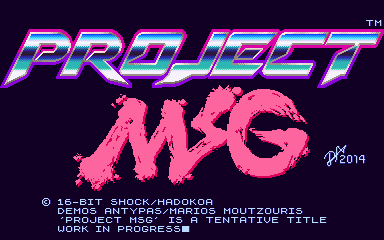
While I’ve mentioned this before, it bears repeating: Project MSG is a tentative title. The true name of the game will be revealed sometime before the actual release. Nevertheless I like setting the tone for the game, early on. I took the liberty of designing a logo even though it’s unlikely to find it’s way on to the Alpha.

The logo is shiny, futuristic with an obvious manga-esque influence – just how I like it. Expect the final logo to follow suit.

ProjectMSG_WorkingTitleScreen
Title screen used for internal development

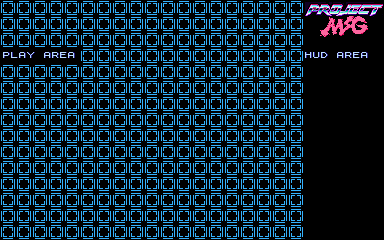
Next in line is probably one of the most important screens. It’s something that players will not get to see but has been invaluable in developing the game. Making good use of display real estate was always going to be a top priority. Also taking into account the varying display sizes, resolutions and aspect ratios that both PC’s and iOS devices come with – this is a tricky proposition.

To retain an authentic retro/pixel art style it was glaringly obvious that the native resolution we should work with must be low. Ideally the resolution we were initially targeting was 320 x 240 pixels which was pretty much the standard for most 16-bit games. However, due to the prevalence of widescreen displays on the PC front that would cause some issues. As a resolution of 320 x 240 has an aspect ratio of 4:3 and the majority of widescreen displays are 16:9 with a few at 16:10.

In order to counter this problem some experimentation was needed, and an elegant solution to be found. Since the majority, if not all the tiles in the game would be at 16 x 16 pixels I decided that the play area had to conform to this. The integrity of the tiles were to be tested on a variety of display setups from crt monitors through to flat screen monitors and televisions. Last but not least, on iOS devices. 

The following screen was created to quickly and efficiently test this out. Our new ideal resolution was also discovered. Almost identical to Capcom’s CP System arcade boards (384 x 224) we went with a native resolution of 384 x 240 pixels. Through extensive testing we found that it works very well with a large variety of displays and aspect ratios, while still giving us a little extra space to work with. We reserved this area for the hud.

ProjectMSG_Prototype01_24Aug2014
Testing….testing

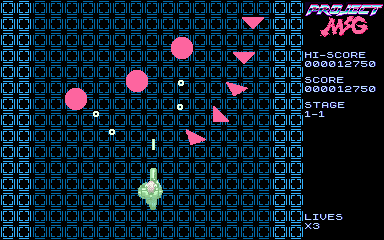
After we had that out of the way, it was time to start putting together our prototype. It wasn’t important to make anything fancy, just something that could be done rapidly but still be fun. An important choice that had to be made was whether to take the bullet hell route or go traditional. While I love bullet hell shmups and own a great deal of them, for a debut release I thought it would be best to go as old skool as possible.

The emphasis was now on enemy formations and less about filling the screen with bullets. It was also vital to ensure that the odds were clearly stacked against the player. While a 2-player option was seriously considered, single player was favoured to capture that more desperate hardcore climate. And also to give the player a strong sense of accomplishment once a stage is cleared.

ProjectMSG_Prototype02_24Aug2014
Prototyping the cyborg shooting action!

Certainly, the prototype is not exactly great looking. It may exude some minimalist style but not even close to the desired art direction. I’ve always been a fan of detailed, crisp and colourful graphics. It would only be natural for me to push my pixels in that direction. Considering that our main character is a cyborg – and in turn the setting would take a techno-fetishistic tone.

It didn’t take too long for those tile maps to start taking form. Soon enough the backgrounds for the first stage were done and put in place. Time to animate our hero sprite and populate the screen with some proper enemies.

ProjectMSG_Stage1_1_24Aug2014
Shoot you before you shoot me 😛

As you’re reading this, development continues on this project. There will be more updates in the near future to keep you posted on how things are coming along. Till next time!