Tag Archives: japan

FM Synthesis & Video Games: Trackers

For this series of FM synthesis music I want to go into a fair bit of detail regarding FM synthesis. Especially experimenting with FM synthesisers to make retro music. However this slightly shorter article is going to give a quick overview of the most popular method for creating retro FM game music.
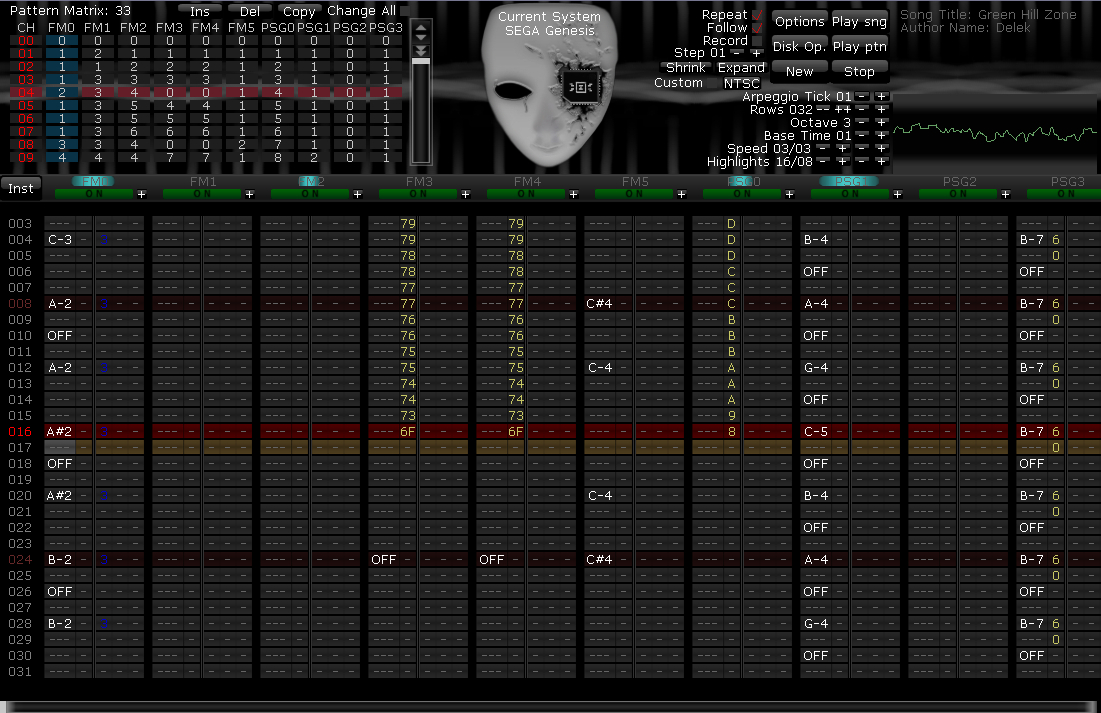
deflemask
DefleMask is one of the most versatile trackers for those seeking to emulate the sounds of Sega’s Master System & Mega Drive consoles

One of the most popular ways to make chiptune music in this day and age is utilising trackers. Trackers are in essence a simplified Digital Audio Workstation (DAW) which rather than being laid out horizontally, for instance how Logic, Ableton, Fruity Loops and other DAW’s are, they are laid out vertically. Typical to trackers are the six following areas:

– Channels (tracks) (these run vertically down and from left to right)

– Notes

– Patterns

– Samples

– Effects

– Orders

There’s some great written and video tutorials online which go in-depth about using trackers so I won’t go into detail here. But essentially trackers work by ordering samples which have been pitched by note value into patterns and orders on the channels. Effects are then used to further enhance the programmed material. Effects in trackers however aren’t the usual reverb, delay, chorus, etc. that you may find in a DAW. But rather ways to add variation to the programmed notes in terms of pitch, stereo positioning and volume. Such effects include Arpeggios, Vibrato, Portamento, Tremolo and Panning.

As mentioned in the previous article there are a number of classic audio chips out there that were used in gaming systems. One chip that was specifically mentioned was the Yamaha YM2612 which was used notably in the Sega Genesis and Megadrive systems. This chip, along with others, have support from such trackers as DefleMask. Meaning you can program audio for specific chips using these trackers.

For further reading (and viewing) I have included some links below of both trackers and tutorials on using them.

Trackers:

http://woolyss.com/chipmusic-chiptrackers.php

http://www.delek.com.ar/deflemask

http://www.milkytracker.org/

Tracker Tutorials:

DefleMask Tutorial 1: https://www.youtube.com/watch?v=eGCsrzaIFDE

Techniques Of Chipping: http://milkytracker.org/docs/Vhiiula-TechniquesOfChipping.txt

Making A Chiptune: https://www.youtube.com/watch?v=-TYyDLElP4c

Throughout my years studying music composition and production I have learnt how to program synthesizers for certain projects. As part of this it was a wise idea to learn how to program FM synthesisers. FM synthesis isn’t as easy to get to grips with as subtractive synthesis but it does reap rewards once learned. So throughout future articles, I will discuss how to program FM synthesisers. In discussion will be programming various sounds and how to get the synths sounding retro. Part of this will be covering numerous techniques of how to achieve the retro sound by means of modern effects such as bitcrushing. But we will also look into what else can be done to give the synthesizers and audio the retro game sound.

Joe Gilliver – BA Hons (Ocular Audio)

Composer | Producer | Sound Designer
www.ocularaudio.com


Cybermanga

Plenty of people have asked about my game project – what is it really about?

I’ve always let them know, that it’s a 2D shooting game set within a cyberpunk universe, with anime/manga influences.

Response has been mostly positive. After all, shooting stuff, cyberpunk worlds and big eyes with speed lines are things of great interest to game fans. Of course one could also add anime, manga and sci-fi enthusiasts in there too.

The beauty of anime and manga is the sheer amount steeped in cyberpunk lore. At a drop of a hat I can think of several titles: Akira, Angel Cop, Appleseed, Battle Angel Alita, Black Magic M-66, Bubblegum Crisis, Cyber City Oedo 808, Cybernetics Guardian, Dirty Pair, Genocyber, Ghost In the Shell, M.D. Geist, Megazone 23, Roujin Z, Serial Experiments Lain and Silent Möbius. And that’s just the short list.

cybercityodeo808
In the future, everyone has great hair

I would recommend, anyone who has even a passing interest in cyberpunk, anime and manga to check out some of the above. If you’ve been playing video games for the past 20+ years, it should not surprise you how much of an influence these have been on your favourite medium.

It’s quite harrowing to pick just one or two titles that have had the biggest influence on me, personally. However, the Appleseed manga just clicked with me two decades ago when I picked up my first copy. Likewise, Akira and Cyber City Oedo 808 both had a profound impact, visually stunning masterpieces that they were and still are.

When I commenced with development of my game, I opted for a cyberpunk theme. Due to the fact that there weren’t too many traditional shooting games based in such a universe. Most tend to be space shooters, which is perfectly fine but didn’t inspire me much to follow suit. It’s not that the concept of a cyberpunk shooting game is terribly original but far less common.

Nevertheless, still a window of opportunity to indulge and create a cyberpunk world with interesting characters that fit the bill. This presented a challenge on how to best depict all this within the boundaries of a two dimensional, top-down viewpoint. How the rich tapestry of manga-infused hyperreality would be brought to life as a shooting game, regardless of confines. 

Fortunately pixel art lends itself beautifully in helping formulate such a world within a retro game format. The tinny, metallic sound of FM synthesis provide the ideal, aural backdrop of a future make-believe dystopia. Cataclysmic electropunk, new wave, synthwave or industrial beats for ersatz cyborgs. All angles are covered.

Sticking feverishly to 80’s neon-noir and anime aesthetics. This was always meant to be a brightly coloured dystopia. The dour mood brought about by modern grey/brown first person shooters have no place in a 16-BIT Shock production. As cheesy and trite as this may sound – I wear shades because the future is bright.


Bass Cadet 03 – Streets Of Rage 2


Bass Cadet 03 hitting you just in time for the weekend!


Streets Of Rage 2 / Bare Knuckle II by the legendary Yuzo Koshiro.