Tag Archives: game dev

Anti-Establishment

16-BIT Shock was set up for a number of reasons, first and foremost to develop quality retro-style games with a sense of purity. This in itself, is a soft form of revolt against mainstream gaming.
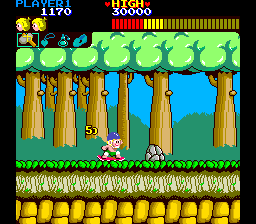
Wonder Boy is a good example of what constitutes a quality game

You may argue that, there are plenty of retro-style games developed in the indie scene these days. Yes, there definitely are. And I happen to be 100% supportive of this. Yet, it still is a revolutionary act to develop these types of games. The mass market is in no way, shape or form encouraging or even supportive of anything that is purely retro.

This is a good thing. A very, very good thing!

If the mass market was truly backing us, not only would we be incredibly uncool. We would be completely irrelevant. For one, we wouldn’t be able to stick out like a sore thumb. And sticking out is what we should be doing – 24/7!

There really are no benefits to pandering to mainstream tastes – none!

I don’t develop games for someone’s grandpa or for someone’s kid. I don’t develop games that you can play with your wife or girlfriend. I don’t develop games that you can play with your family. I don’t develop casual games. I don’t develop social games. I don’t develop multiplayer games.

I develop games strictly for the enthusiast. Particularly the retro game enthusiast.

The reason is simple. I’m an enthusiast myself and just can’t relate with any of the other types of gaming niches. Other people may enjoy them and that’s perfectly fine. I just won’t do them.

I may have come across a bit condescending in this article. To a certain extent, that’s true. Game enthusiasts like myself, who have been gaming for over 3 decades do have a stake in this. We’ve been supporting this medium for a considerable amount of time, and our opinion counts.
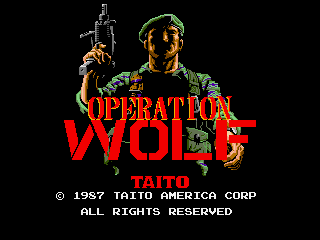
Just the title screen of Operation Wolf is manlier than 95% of today's weak sauce games
Just the title screen of Operation Wolf is manlier than 95% of today’s weak sauce games

Back in the 80’s, popular, mainstream games were: Ghosts ‘n Goblins, Wonder Boy, Green Beret, 1942, Bubble Bobble, Afterburner, Out Run, Gradius, Arkanoid, Operation Wolf, Combat School, Strider and Twin Cobra. What they share in common is that they were all well-made, highly entertaining games and far superior to their modern counterparts.

For the most part, what passes for mainstream and popular nowadays, is a terrible joke. The fact, that games like Angry Birds and that other backroom abortion – Flappy Bird, are a massive success – is telling. No, these are not good games. I don’t want to use expletives, but I will say one thing – these are games fit only for the latrine. 

And that’s what I’m effectively revolting against. And I trust this applies to any self-respecting game creator reading this.

Fight the establishment! Make good games!


An Introduction to FM Synthesis & Ocular Audio

As someone that grew up with arcade games and 80’s synthpop music, I cannot hide my fondness for FM Synthesis. This was the sound of the future and in a somewhat mystical way, still is.

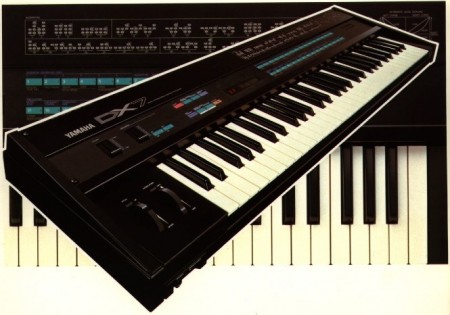
It can sound tinny, aggravatingly metallic or warm and bass-heavy. Aural landscapes that are representative of both happy, fuzzy worlds and those that are dystopian. Light and darkness all produced in an embedded range of chips manufactured by Yamaha. These chips would find a home in Yamaha’s famous DX7 digital synthesizers, arcade boards and PC sound cards from AdLib and Creative Lab’s early Sound Blaster range.

Yamaha's DX7 - The Workhorse Of Many Hit Songs
Yamaha’s DX7 – The workhorse of many hit songs

Enough can’t be said about all the sounds that were coming out of all these synthesizers, arcade cabinets and sound cards. Sounding incredibly synthetic, plastic even. And somehow they became relevant in a sea of naysayers. Melodies were supposed to be the preserve of the musician who could actually play real instruments, not some midi punk.

In a sense, keyboard players and sound coders were in all likelihood working harder than the average traditional musician. Many electro/synthpop bands were notorious for spending hours on end, tweaking the settings on their synthesizers to get a unique sound- they could call their own.

At the other camp, programmers would often hand code sound routines in assembly in order to fit in the music. Given the memory limitations of home computers, consoles and arcade systems during that time period, this was not exactly an easy task to achieve. Not to mention that FM synthesis is known for it’s quirks and complexity.

Over the past few months I’ve come into contact with a composer that specializes in audio production for games and film. Joe Gilliver – BA Hons of Ocular Audio has been kind enough to write the next article for my blog, which will cover FM synthesis deeper. Joe is based in the UK and is currently working on a project called Black Shuck.

Apart from demystifying FM synthesis, Joe has also written this article which gives greater insight of his current project at Gamedev.net.


The 16-BIT Shock Design Philosophy

There are many developers that I admire, mostly emanating from Japan, crafting video games as far back as the early 80’s. Growing up during that period I was fortunate enough to enjoy many early works from the likes of Capcom, Data East, Konami, Irem, Namco, Nichibitsu, Sega, Seibu Kaihatsu, SNK, Taito, Tecmo, Technos and Toaplan to name a few. My initial exposure to their games was through various arcade releases and home computer ports — some poor, some mediocre and others simply mind-blowing!

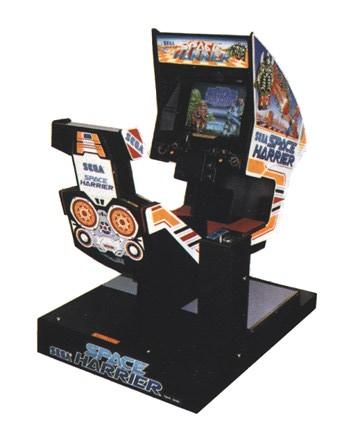
An original Space Harrier arcade cabinet

Be that as it may, time has moved on and so has technology. We’re now 30 years removed from back then and games have changed drastically. Furthermore, gamer tastes are quite different, at least within the mainstream. Retro gamers are still keeping the old flame burning on. Wonderful of them for doing so.

Personally, as a game creator, it would make sense to venture deeply into my own tastes and experiences within the medium. Taking a close look at both past and present examples in order to discover the pinnacle.

If I was obligated to pick only one era in the history of video games that could be clearly defined as exemplary, my answer would be the 16-bit era. Any true gamer worth his salt would respond likewise. The finest games, legendary console systems and revered coding houses were doing the business between 1987 to around 1995.

Great games were developed before and after this period, however the zenith particularly for 2D games occurred during the age of 16-bit. Keeping the fundamentals of the pioneering 8-bit generation, but enhancing and refining control, play, visuals and sound in such a way that a significant leap forward was achieved.

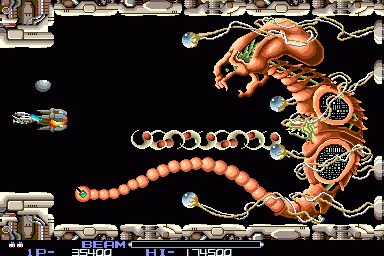
Irem knew a thing or two about making shmups

Which finally brings forth the point of this article. I choose to have a design philosophy, that is,  purist to the core in following conventions that are steeped in tradition of that generation. Retaining the tight core game mechanics, challenge levels, intricately detailed pixel art and melodious chip music that made this amazing period. Avoiding to over-engineer and adding any unnecessary tropes found in modern gaming that would water down the final outcome.

Experimentation and some interesting surprises are destined to become part of my projects. Considering my approach is retrospective in nature, does not mean that I subscribe to any limiting convictions, in terms of game design and narrative. Plenty of room will be given to allow the unexpected to take place.