Tag Archives: FM Synthesis

Project MSG – The Retro-Punk Experience

Last month I was able to reveal a little about the game project that I’ve been working on. Shares, retweets, favourites, +1’s and feedback via messages and email from many of you has been both positive and very encouraging – thank you!

It seems that the ‘Project MSG’ logo made a strong impact. The response that I received, while not entirely unexpected, was rather more enthusiastic than anticipated. While I do concur that it’s a cool looking logo. And as the creator of this logo I would like to add that I do so in a humble and non-boisterous manner. What matters is that you love it!

ProjectMSG_WhiteBackground
I should consider taking t-shirt orders 🙂

The logo has managed to convey and stir up strong nostalgic feelings of 8-bit & 16-bit gaming memories for you lot. As if the mid-80’s or even early 90’s were no longer some forgotten bygone era. I have no intention in ruining those feelings and you can all rest assured that the official logo will still retain this flavour.

Fortunately, you didn’t just like the logo. There was a single screenshot of ‘stage 1-1’ of the game which managed to attain significant attention. Plus a fair amount in the twittersphere. Detailed pixel art graphics are gladly still welcome among retro game fans. This singular shot only gives a small glimpse of the game, but it’s enough to give a basic idea of the styling and gameplay.

Defining this project becomes easier as work progresses. While the initial brief described it as 2D shooting game with a cyberpunk theme. This is still true for the project today. However, newer aspects start to surface that were faintly observed in the initial stages of development.  Comparatively to, an alter ego of some kind, quietly hiding within the shadows of the dominant personality. Only to make itself known at a later date.

Perhaps it all boils down to the aesthetic choices. The clashing of pixel art and FM-synth generated music, while a natural fit gives out a far more raw electronic feel. Due to modern development techniques and increased processing power, we have become accustomed to games that are incredibly slick and shiny. Nothing wrong with this intrinsically. After all, I’m all for high production values and polish in the creation of video games. It’s just that this added fidelity often constitutes in a loss of a raw edge.

This rawness is ultimately part of the charm. It’s not just a retro-centric attribute that I’m pointing out here. It’s inherently punk in nature. Sticking out like a sore thumb, provoking the player that it’s nothing like those big-budget, overproduced but somehow sterile games. Project MSG wants to get dirty!



Introducing Project MSG

It’s finally time to start revealing a little more about the project I’ve been working on. This is a game I’m co-developing with Hadokoa  – an iOS app development specialist. 16-BIT Shock focuses on conceptualizing, prototyping and developing the game for PC. Hadokoa on the other hand, tests and fine tunes my builds and ports to the iOS devices. Both 16-BIT Shock and Hadokoa will make a combined effort in promoting and marketing the game for maximum reach.

The working title for the game is – ‘Project MSG’. This is a tentative title and subject to change before release, whereby the real title will be revealed.

As mentioned in my Cybermanga post, this is a retro-style 2D shooting game based in a cyberpunk universe. To elaborate further, it’s a single player experience with a strong focus on the main hero character. Unfortunately I cannot reveal the name of the hero, as that would give the actual game title away. Suffice to say the hero is a cyborg who is tasked with the unenviable job of dealing with some pretty nasty terrorists.

This brings us to the game’s difficulty. Given the backdrop of a singular man-machine against a legion of mechanical and bio-mechanical enemies. Our hero is hugely outnumbered and outgunned. It should come as no surprise that the prognosis for survival is far from high. Project MSG is destined to provide the ultimate balls to the wall shooting escapade and white knuckle ride.

Restrictions have also intentionally been applied to further aggravate eventualities. Limitations are set on movement, creating a somewhat claustrophobic play style. Avoiding enemy fire will be the preserve of the dedicated, skilled player. All enemy patterns and stages are carefully handcrafted and absolutely nothing is procedurally generated, as seems to be the trend with the current crop of indie games.

End of level bosses will also be present. What would any good arcade shooter be without a tough as nails boss at the end of each stage? Nothing seals the deal of accomplishment once the end level guardian has been brought to it’s knees. Bosses will also play an integral part in the story while sporting some wickedly cool antagonism.

The general direction of the story is headed toward transhumanist territory. This too, should not surprise, given the cyberpunk leanings of the project. The hero of the game will be dealing with his posthuman reality as the story unfolds. Likewise, his enemies face a similar predicament as they too are cyborgs. But that’s as far as I’m going to go on about the story for now. In fact, story updates will be kept to an absolute minimum right through to release of the game. This is done to avoid spoilers.

16-BIT Shock Blows My Fucking Mind
Screenshots in 2 weeks time?! My mind is blown!!

Now to conclude with the most important bit of information in this post. The first screenshots of Project MSG will be released on the 30th of July 2014. These will consist of 4 screen grabs initially but more will be added to the upcoming gallery as the game nears completion. In two weeks from now – prepare for the first barrage of cyborg shooting madness!!


FM Synthesis & Video Games: Trackers

For this series of FM synthesis music I want to go into a fair bit of detail regarding FM synthesis. Especially experimenting with FM synthesisers to make retro music. However this slightly shorter article is going to give a quick overview of the most popular method for creating retro FM game music.

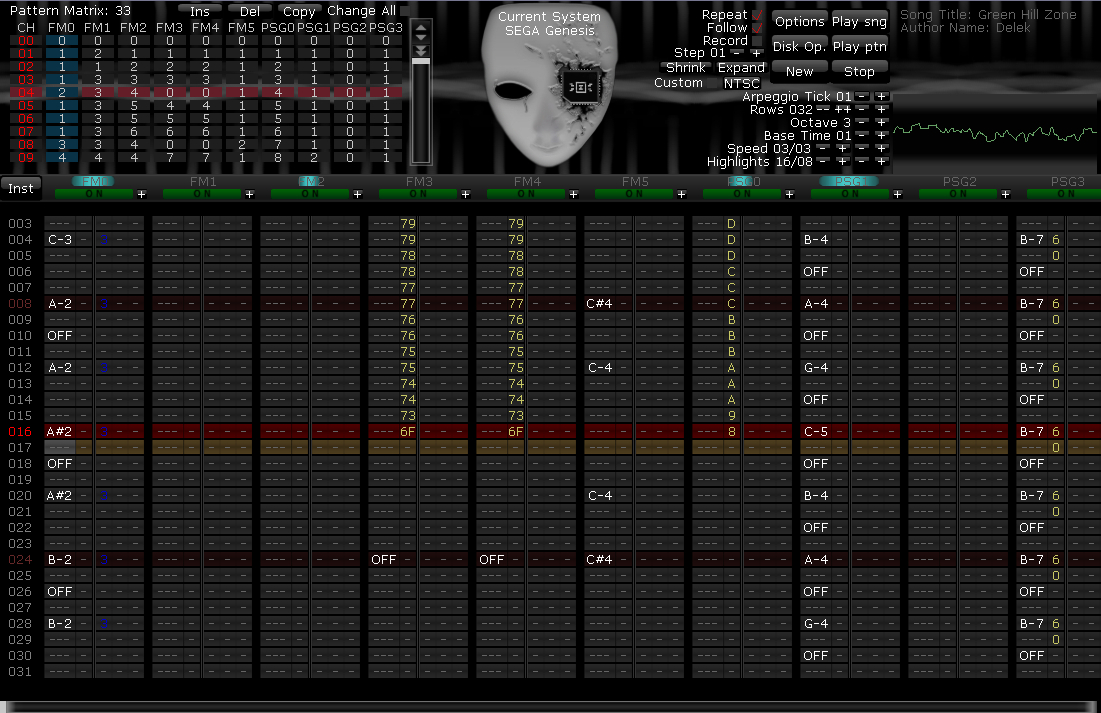
deflemask
DefleMask is one of the most versatile trackers for those seeking to emulate the sounds of Sega’s Master System & Mega Drive consoles

One of the most popular ways to make chiptune music in this day and age is utilising trackers. Trackers are in essence a simplified Digital Audio Workstation (DAW) which rather than being laid out horizontally, for instance how Logic, Ableton, Fruity Loops and other DAW’s are, they are laid out vertically. Typical to trackers are the six following areas:

– Channels (tracks) (these run vertically down and from left to right)

– Notes

– Patterns

– Samples

– Effects

– Orders

There’s some great written and video tutorials online which go in-depth about using trackers so I won’t go into detail here. But essentially trackers work by ordering samples which have been pitched by note value into patterns and orders on the channels. Effects are then used to further enhance the programmed material. Effects in trackers however aren’t the usual reverb, delay, chorus, etc. that you may find in a DAW. But rather ways to add variation to the programmed notes in terms of pitch, stereo positioning and volume. Such effects include Arpeggios, Vibrato, Portamento, Tremolo and Panning.

As mentioned in the previous article there are a number of classic audio chips out there that were used in gaming systems. One chip that was specifically mentioned was the Yamaha YM2612 which was used notably in the Sega Genesis and Megadrive systems. This chip, along with others, have support from such trackers as DefleMask. Meaning you can program audio for specific chips using these trackers.

For further reading (and viewing) I have included some links below of both trackers and tutorials on using them.

Trackers:

http://woolyss.com/chipmusic-chiptrackers.php

http://www.delek.com.ar/deflemask

http://www.milkytracker.org/

Tracker Tutorials:

DefleMask Tutorial 1: https://www.youtube.com/watch?v=eGCsrzaIFDE

Techniques Of Chipping: http://milkytracker.org/docs/Vhiiula-TechniquesOfChipping.txt

Making A Chiptune: https://www.youtube.com/watch?v=-TYyDLElP4c

Throughout my years studying music composition and production I have learnt how to program synthesizers for certain projects. As part of this it was a wise idea to learn how to program FM synthesisers. FM synthesis isn’t as easy to get to grips with as subtractive synthesis but it does reap rewards once learned. So throughout future articles, I will discuss how to program FM synthesisers. In discussion will be programming various sounds and how to get the synths sounding retro. Part of this will be covering numerous techniques of how to achieve the retro sound by means of modern effects such as bitcrushing. But we will also look into what else can be done to give the synthesizers and audio the retro game sound.

Joe Gilliver – BA Hons (Ocular Audio)

Composer | Producer | Sound Designer

www.ocularaudio.com