Tag Archives: 80s

The Month That Was

June was the launch month for this blog. It was a busy and interesting month with some surprising results. In all honesty, I wasn’t expecting much in the way of traffic. The majority of blogs hardly get much of a readership, within the first 6 months of operation. 16-BIT Shock on the other hand enjoyed a constant stream of daily visitors. Several spikes occurred during the month, further bumping up overall traffic to the site.

It was also really great that so many views came from so many different countries. To be exact, 31 countries within a 30 day period. Here are the top 10 countries by rate of views:

  1. United States
  2. South Africa (where 16-BIT Shock is based)
  3. United Kingdom
  4. Greece
  5. Canada
  6. Japan
  7. Brazil
  8. Mexico
  9. Netherlands
  10. Italy

Honourable mentions also go to visitors from: Germany, Russia, Portugal, Australia, Finland, Sweden, Hungary, France, Spain, Belgium, New Zealand, Norway, Israel, Ireland, Latvia, Denmark, Morocco, Iceland, Malaysia, Honduras and Columbia.

I appreciate that so many of you took the time to visit this site, read the articles and even shared with your friends & followers on the various social media channels. It’s even better to know that there’s a keen interest in retro gaming among the majority of you. The articles will only get better in the coming months with an increased focus on the project I’ve been working on.

For those of you who have waited patiently for more information on this project –July is your month!

I have several articles lined up that will go into greater detail about this game project, the development process and the release of the first screenshots to ever be made public. Exciting stuff and sure to fire up a few retro heads out there.

And for those that enjoyed Joe Gilliver’s FM Synthesis article, are also in for a treat. Joe’s busy preparing another one that will go further into the technicalities. Want to make your own FM-based chiptune tracks or wondering what the fuss is all about? Joe is an expert in the field and will be shining some light on what is deeply niche subject matter.

Bass Cadet will continue being a mainstay of this blog but will probably be reduced to 2-3 posts per month. The reason for this is because the emphasis will now shift towards game development updates. All in all, it’s looking like an even more interesting month ahead. Stay retro, folks 🙂


Anti-Establishment

16-BIT Shock was set up for a number of reasons, first and foremost to develop quality retro-style games with a sense of purity. This in itself, is a soft form of revolt against mainstream gaming.

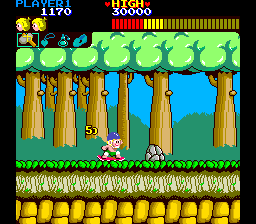
Wonder Boy is a good example of what constitutes a quality game

You may argue that, there are plenty of retro-style games developed in the indie scene these days. Yes, there definitely are. And I happen to be 100% supportive of this. Yet, it still is a revolutionary act to develop these types of games. The mass market is in no way, shape or form encouraging or even supportive of anything that is purely retro.

This is a good thing. A very, very good thing!

If the mass market was truly backing us, not only would we be incredibly uncool. We would be completely irrelevant. For one, we wouldn’t be able to stick out like a sore thumb. And sticking out is what we should be doing – 24/7!

There really are no benefits to pandering to mainstream tastes – none!

I don’t develop games for someone’s grandpa or for someone’s kid. I don’t develop games that you can play with your wife or girlfriend. I don’t develop games that you can play with your family. I don’t develop casual games. I don’t develop social games. I don’t develop multiplayer games.

I develop games strictly for the enthusiast. Particularly the retro game enthusiast.

The reason is simple. I’m an enthusiast myself and just can’t relate with any of the other types of gaming niches. Other people may enjoy them and that’s perfectly fine. I just won’t do them.

I may have come across a bit condescending in this article. To a certain extent, that’s true. Game enthusiasts like myself, who have been gaming for over 3 decades do have a stake in this. We’ve been supporting this medium for a considerable amount of time, and our opinion counts.

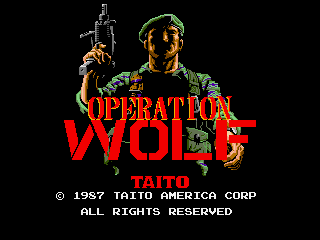
Just the title screen of Operation Wolf is manlier than 95% of today's weak sauce games
Just the title screen of Operation Wolf is manlier than 95% of today’s weak sauce games

Back in the 80’s, popular, mainstream games were: Ghosts ‘n Goblins, Wonder Boy, Green Beret, 1942, Bubble Bobble, Afterburner, Out Run, Gradius, Arkanoid, Operation Wolf, Combat School, Strider and Twin Cobra. What they share in common is that they were all well-made, highly entertaining games and far superior to their modern counterparts.

For the most part, what passes for mainstream and popular nowadays, is a terrible joke. The fact, that games like Angry Birds and that other backroom abortion – Flappy Bird, are a massive success – is telling. No, these are not good games. I don’t want to use expletives, but I will say one thing – these are games fit only for the latrine. 

And that’s what I’m effectively revolting against. And I trust this applies to any self-respecting game creator reading this.

Fight the establishment! Make good games!


Shooting & Dodging

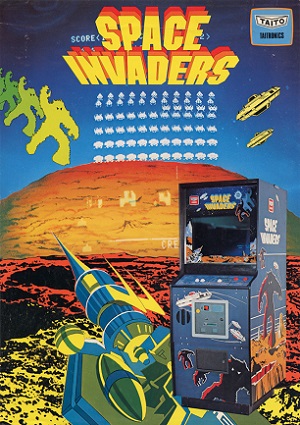
When Space Invaders was released way back in 1978, invariably it would lay down the fundamentals of the shooting game genre. We may refer to this genre simply as shooting games, shmups or even STG’s as the Japanese prefer to call them.

The Grand Daddy of shooting games

However, I wish to clear something up first. A game like Space Invaders is not a shmup in the true sense. This is often a reference to shooting games that have a forced scrolling background either horizontally or vertically. At the very least, Taito’s Space Invaders can be defined as a proto-shmup for lack of a better term.

Genre categories and deviations are not that important right now. The core game mechanics of all shooting games are similar. As the title of this post clearly indicates, it’s all about shooting and dodging. Simple really, almost primal. That’s the main draw after all, shooting the enemy while avoiding  getting hit yourself.

Computers have always been able to handle shooting games incredibly well. It’s a piece of cake for even underpowered systems to make things appear and disappear on screen. All this may give the impression that developing  a shooting game is easy peasy!

If only that were the case. Simplicity should never be underestimated in regards to making things – easier. It takes some deft skills and an elegant touch to piece together a playable shooting game. Developing one for commercial release will often require months of play-testing and polish.

Shooting games also demand a sharp eye for detail. Not just the visual aspect, but also every single enemy placement, every movement and every pattern. And it doesn’t stop there, every bullet that will be fired, direction of fire and even colour, size and damage it can inflict all have to be taken into account. In some cases, these can all total up to over a hundred sprites on screen at once.

With so much happening on the screen, there is plenty that can go wrong. The worst in my opinion is leaving very little wiggle room for the player. So incredibly confined that a direct hit is often unavoidable, thus rendering the game either unfair or unplayable. Reducing the size of the player sprite hitbox is a common solution. My preferred method to solve this issue is smart enemy placement and firing rates.

There are various other solutions, but I won’t go further now. What’s vital is ensuring that shooting and dodging are both fun. It’s essentially the yin and yang of the majority of shooting games and what makes them addictive.