Tag Archives: 8-bit

Tools Of The Trade – GameMaker : Studio

indie,Indie,INDIE,game,Game,GAME,gamedev,Gamedev,GameDev,development,Development,tool,tools,80s,80's,90s,90's,animo,Animo,GameMaker,gamemaker,game-maker,game maker,maker,Maker,studio,Studio,STUDIO,2d,2D,platformers,shooters,shmups,shmup,SHMUP,SHMUPS,retro,RETRO,Retro,8bit,8-bit,8 bit,16bit,16-bit,16 bit,16-BIT,16 BIT,16BIT,16-Bit,16 Bit,16Bit,compu,computers,micro,computer,Microcomputer,easy,easier,easiest,old,school,skool,old-skool,cool,cooler,coolness,Cool,COOL,arcade,Arcade,arcades,Arcades,ARCADE,ARCADES,mame,MAME,Mame,snk,Snk,SNK,Sega,SEGA,sega,capcom,Capcom,CAPCOM,Nintendo,NINTENDO,nintendo,jaleco,Jaleco,JALECO,taito,TAITO,Taito,tech,techno,TECH,TECHNO,technology,Technology,technologies,TechnologiesGameMaker first came to my attention around 2006 as a creation tool and engine for 2D games. While I had my doubts of it’s abilities, I was intrigued enough to try it out. I remember first spending a weekend with it, gradually figuring out the basics. While there were some quirks (and still are) of how GameMaker handles a few things, first impressions were rather good.

It didn’t take long to ascertain that GameMaker does exactly what it’s meant to do. Developing games through it’s point and click interface was indeed a reality. Creating something more involved is also possible through it’s scripting language – GML. The long and short of it is that GameMaker is a competent and easy-to-use framework, primarily for 2D game development. However, users proficient in GML have been able to put together some impressive 3D games as well.

Unfortunately there is a degree of prejudice towards using tools such as GameMaker, primarily emanating from quarters of the development community. Various perceptions exist that are not entirely grounded. There’s a tendency to believe that a professional product cannot be crafted with such engines – a false assessment considering the quality of games already delivered using GameMaker.

Personally I do veer on the side that it would be better for developers to create their own custom engines. The reality is that this is just not a cost-effective solution in the long run. Months or even years developing an in-house engine could be better spent working on the actual game. No point in reinventing the wheel when off-the-shelf  engines are capable of tangible results.

Retro-style games are generally not very involved and therefore don’t overwhelm system resources. In fact, adding too many elements will effectively diminish a desirable retro-feel. Keeping a minimalist mindset is thus essential when creating such games. I’m using the latest iteration of GameMaker: Studio and have found that it’s capable of handling a great variety of complex, in-game systems and mechanics. It’s certainly not a package that is limited to crafting the type of indie retro experience that has become popular as of late.

Another area that a tool like GameMaker: Studio comes in handy is for rapid prototyping purposes. Simple ideas may be implemented and tested in a matter of minutes. My hard drive is flooded with a bunch of prototypes and mini-games I’ve put together over the years. A few of those are fun and interesting enough to be turned into commercially viable games. Just requiring a bit more development time and polish to come into their own.

As anyone reading this article can tell by now, my general experiences with GameMaker have been positive. I’ve enjoyed using this package as a hobbyist for several years now. While I’ve always wanted to release games in marketable form, other business and personal commitments made this difficult. A few relevant changes have occurred recently which affords me the opportunity to finally have a go at it.

The games that I will be releasing under the 16-BIT Shock banner will be small in scale, bite-size experiences. Short development cycles will be scheduled for the majority of projects. Longer, ambitious titles are also on the radar but will be determined on how feasible these are. Either way I will strive to ensure that all titles are stylish and gloriously retro.

A Winner Is You!


FM Synthesis & Video Games: Kick Drums & Toms

Let me start this blog post by apologising for my lack of words on digital paper over the past few months. Life got in the way a touch too much with a change in jobs and numerous video game projects starting which have occupied all of my free time. It is very nice to now be in a position to share some knowledge (however limited it may be) with yourselves again.

This post is going to address what I, as a drummer, consider the grounding force of any track, the kick drum. As well as discussing the kick drum and how to create them utilising FM synthesis, tom toms, the nature of which are very similar to kick drums will also be covered.

Tonal Characteristics Of Kick Drums & Toms:

Let’s dive into this post by thinking about the typical characteristics of a kick drum. In a lot of modern music the kick drum, along with the bassline, is the root of the track. Together they provide the backbone of many productions, helping to drive compositions along and provide a strong foundation for the rest of the production to be built upon. The same can also be said for chiptunes. The majority of the time it is the bassline that provides the driving force, often reinforcing the kick drum on the beat. In some systems, such as the NES, the triangle waveform channel can be pitched down at the start of the notes to give the impression of a deeper sound, further reinforcing the kick drum.

As just discussed the typical sound for a kick drum is one that provides the foundation to the track. As such they tend to be quite punchy, so it may be said to have a quick attack and quick decay with regards to their envelope. The majority of the time tom toms do have a similar envelope to kick drums. However extending the release of the envelope, which will be discussed in the next section, gives the tom a more open and sustained sound, as you would hear if you physically struck a tom tom in real life.

Kicks also tend to be low in pitch, so it can be said that the frequency content consists of low frequencies, or at least frequencies in the lower range. This is the main area where kick drums differ from toms, as tom toms have varying pitches depending on their size, or implied size when it comes to the digital realm. The larger the tom the lower its tone, the smaller the tom the higher its tone.

Understanding these two fundamentals are the building blocks for pretty much every percussive sound you will encounter. Once you have grasped the basics of these the world is your percussive oyster.

Envelope Shape:

If you are new to synthesis you may be wondering what an envelope it. Let’s clarify that in this case it definitely doesn’t transport pieces of paper from one location to another. When it comes to synthesis an envelope helps shape the sound. Shaping the overall outcome of any sound in a synthesiser is done via the amplitude (volume) envelope. So in the case of a kick drum the amplitude (volume) envelope will be the tool to shape the sound so that it has the right attack and decay.

As an example let’s take a look at how this can be done in an FM synth. My synth of choice at this stage is going to be Logic Studio’s EFM1. This synth is laid out in a very straight forward manner and helps with understanding the basics of FM synthesis. For the examples in this tutorial we aren’t actually going to implement any direct frequency modulation synthesis as these sounds can be created without any. However the sounds can be enhanced with frequency modulated synthesis and this will be demonstrated further down the line.

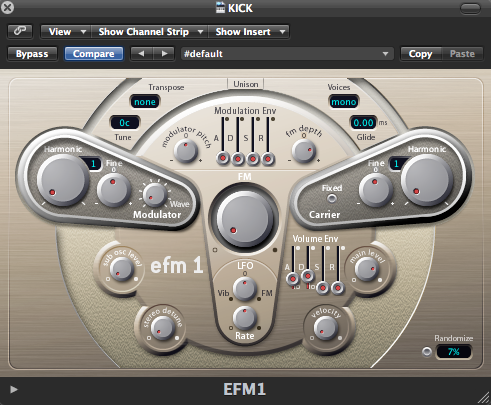
  • Starting with a blank canvas let’s take a look at the aspects of an envelope. These are the attack, decay, sustain and release. In this example we are editing the amplitude (volume) envelope as this controls the overall shape of the sound. Notice the volume envelope on the bottom right hand corner of this synth. This is what we will be focusing on today.Logic,Logic Studio,Logic studio,logicstudio,logic,studio,click,clicky,drum,drums,daw,DAW,fm,FM,synth,synthesis,Synthesis,chiptune,vgm,game,music,retro,retrogaming,electronic,electronica,electro,synthwave,wave,Synthwave,80s,80's,90s,90's,apple,Apple,Mac,mac,Macintosh,compose,composer,composition,produce,producer,production,808,roland,Roland,beat,beats,box,alt,alternative,pop,popular,mainstream,underground,micro,microcomputer,microcomputers,sample,samples,sampling,1bit,1-bit,2bit,2-bit,4bit,4-bit,8bit,8-bit,12bit,12-bit,15bit,15-bit,16bit,16-bit,24bit,24-bit,bit,khz,Khz,rate,envelope,sustain,decay,attack,release,random,randomise,randomize,transpose,unison,voice,voices,Voice,Voices,vocal,Vocal,2d,2D,2-D,2 D,2 d,glide,Glide,shock,Shock,SHOCK,16-BIT Shock,tune,tunes,itunes,iTunes,tuning,Tune,TUNE,Tunes,TUNES,song,songs,SONG,SONGS,songwriting,writing,future,FUTURE,futuristic,acid,ACID,house,House,acid-house,acieeed,aciiieeed,ebm,EBM,body,indie,Indie,INDIE,dev,development,Development,program,progamming,programmer
  • As a kick drum has a short sound that starts instantly you want a very fast attack, short decay, little or no sustain and a very short release. As can be seen from the image above the attack slider is very far down, pretty much at the bottom. This creates an instant start to the sound. The sound has a very slight decay which creates the punch to this sound, especially with the release being all of the way down. The sound clip below demonstrates what this sounds like.
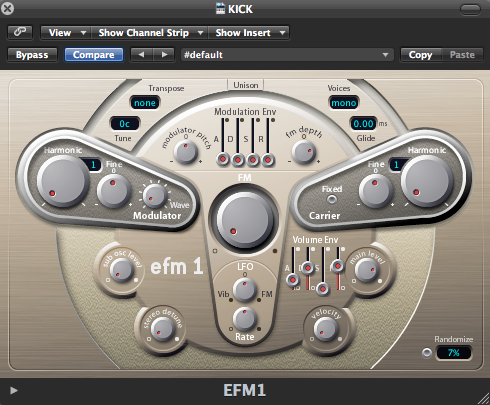
  • To get fatter, slightly longer sound you can extend the attack slightly, as in the image below. Extending the attack slightly removes that click at the start of the sound and instead gives it a rounded sound at the beginning. The decay can also be extending a tiny amount to let the kick sound play for long when the midi note or midi keyboard is played. An example of what it sounds like is below.Logic,Logic Studio,Logic studio,logicstudio,logic,studio,click,clicky,drum,drums,daw,DAW,fm,FM,synth,synthesis,Synthesis,chiptune,vgm,game,music,retro,retrogaming,electronic,electronica,electro,synthwave,wave,Synthwave,80s,80's,90s,90's,apple,Apple,Mac,mac,Macintosh,compose,composer,composition,produce,producer,production,808,roland,Roland,beat,beats,box,alt,alternative,pop,popular,mainstream,underground,micro,microcomputer,microcomputers,sample,samples,sampling,1bit,1-bit,2bit,2-bit,4bit,4-bit,8bit,8-bit,12bit,12-bit,15bit,15-bit,16bit,16-bit,24bit,24-bit,bit,khz,Khz,rate,envelope,sustain,decay,attack,release,random,randomise,randomize,transpose,unison,voice,voices,Voice,Voices,vocal,Vocal,2d,2D,2-D,2 D,2 d,glide,Glide,shock,Shock,SHOCK,16-BIT Shock,tune,tunes,itunes,iTunes,tuning,Tune,TUNE,Tunes,TUNES,song,songs,SONG,SONGS,songwriting,writing,future,FUTURE,futuristic,acid,ACID,house,House,acid-house,acieeed,aciiieeed,ebm,EBM,body,indie,Indie,INDIE,dev,development,Development,program,progamming,programmer
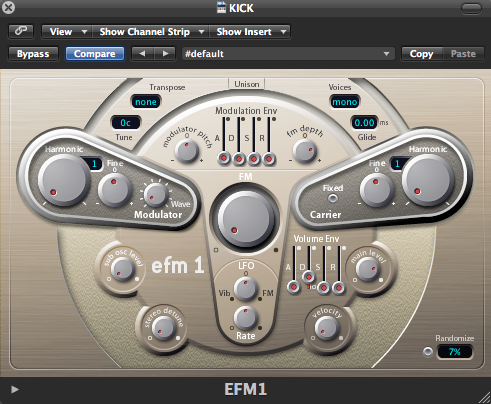
  • Or to have a longer kick sound with less punch, much like an 808 style kick, you can extend the release to suit your taste. Extending the release will also give the tom tom sound, which will be noticed if the the sound is played higher pitched. The image below shows what the amplitude envelope will look like in these cases.Logic,Logic Studio,Logic studio,logicstudio,logic,studio,click,clicky,drum,drums,daw,DAW,fm,FM,synth,synthesis,Synthesis,chiptune,vgm,game,music,retro,retrogaming,electronic,electronica,electro,synthwave,wave,Synthwave,80s,80's,90s,90's,apple,Apple,Mac,mac,Macintosh,compose,composer,composition,produce,producer,production,808,roland,Roland,beat,beats,box,alt,alternative,pop,popular,mainstream,underground,micro,microcomputer,microcomputers,sample,samples,sampling,1bit,1-bit,2bit,2-bit,4bit,4-bit,8bit,8-bit,12bit,12-bit,15bit,15-bit,16bit,16-bit,24bit,24-bit,bit,khz,Khz,rate,envelope,sustain,decay,attack,release,random,randomise,randomize,transpose,unison,voice,voices,Voice,Voices,vocal,Vocal,2d,2D,2-D,2 D,2 d,glide,Glide,shock,Shock,SHOCK,16-BIT Shock,tune,tunes,itunes,iTunes,tuning,Tune,TUNE,Tunes,TUNES,song,songs,SONG,SONGS,songwriting,writing,future,FUTURE,futuristic,acid,ACID,house,House,acid-house,acieeed,aciiieeed,ebm,EBM,body,indie,Indie,INDIE,dev,development,Development,program,progamming,programmer

Harmonic Content:

Deciphering the harmonic content of a sound will allow you to select which waveform the sounds will consist of. Chiptunes typically consist of simple waveforms such as saw, square, triangle and sine waves. So when composing chiptune sounds you really want to keep to these simple waveforms. However the way FM synthesis works is by modulating one waveform with the frequency of another waveform. This creates very complex waveforms and the maths behind it can get very complex. So for the next few articles the EFM1 will my weapon of choice to explain basics of FM synthesis and how sounds can be created. For instance a future article will discuss how to create a short pitch bend at the start of drum sounds to further enhance them. As the maths can get very complicated with FM synthesis a lot of the time once you have the basics down and understand how it works it is best to refine sounds by ear.

If you listen carefully to kick drums and tom toms you will hear that they are quite plain in harmonic content. That is they don’t have the raspy sound of a saw wave, or the slightly raspy but more hollow sounding square wave. In my opinion they are best constructed from sine waves, which is the simplest waveform as it contains no harmonics aside from the root frequency. The sounds you hear above don’t involve any frequency modulation to effect their pitch or tone. So later articles will show how to incorporate frequency modulation into what is currently existing here to see how the sounds can be modified.

Joe Gilliver – BA Hons (Ocular Audio)

Composer | Producer | Sound Designer

www.ocularaudio.com


Simplicity

Taito is a game company I’ve always had a soft spot for. We don’t hear much from them these days but they are still around. I believe they were bought by Square Enix as of 1995 and the rest as they say, is history. Sadly, it seems that Taito is now a shell of it’s former self – an arcade heavyweight with an enviable back catalogue.

80s,90s,80's,90's,retro,retrogaming,gaming,games,juegos,taito,arkanoid,arkanoid2,2,revenge,of,doh,arcade,arcades,8bit,8-bit,16bit,16-bit,logo,developer,gamedev,corporation,toaplan,technos,skyshark,space,invaders,sky,shark,flying,gun,buster,frontier,layer,section,elevator,action,2d,platformer,platformers,shmup,shmups,puzzle,puzzler,breakout,break,out,square,enix
Taito’s older company logo

Responsible for a prolific assortment of hits such as Arkanoid, Arkanoid – Revenge of Doh, Bubble Bobble,  Buggy Challenge, Chase H.Q., Darius, Elevator Action, Exerion, Gun Frontier, Gyrodine, KiKi KaiKai, Layer Section, Operation Wolf, Operation Thunderbolt, Rastan, Runark, Slap Fight, Space Invaders, The Legend of Kage,  The New Zealand Story, The Ninja Warriors, Volfied – and that’s just the tip of the iceberg. There are plenty more that I have missed, excluding games Taito published from the likes of Toaplan & Technos Japan Corp.

The majority of titles mentioned above are lauded enthusiastically by retro game fans, worldwide. Certainly Taito provided the good times, leaving many of us with fond memories. Simple games, stylish games, colourful games with straightforward missions and game play. Hundred percent arcade experiences with no false pretense of attempting to be anything other.

I guess one of the charms of a Taito game is in it’s pure simplicity. No unnecessary bells and whistles to cloud proceedings. Leaving us with nothing more but a video game in it’s utmost sincerest form. Arkanoid and it’s sequel – Revenge of Doh, exemplifies this splendidly. While essentially a Breakout clone at it’s core, Arkanoid bends a few rules and eventually comes into it’s own. Power-up capsules, enemy ships and cleverly laid out brick formations helped to elevate it above Breakout and other similar clones.

80s,90s,80's,90's,retro,retrogaming,gaming,games,juegos,taito,arkanoid,arkanoid2,2,revenge,of,doh,arcade,arcades,8bit,8-bit,16bit,16-bit
A stylish logo for a stylish game

Nevertheless, even with those few additions, Arkanoid and Revenge of Doh are amazingly simple and addictive games. And I never tire returning for another go. They hold up well to this very day, still exuding a fine and dapper air while never having lost the fun factor. Everyone with even a passing interest in games should experience both at some point in their lives.

From a game developer’s standpoint, much can be garnered from Taito’s past output. I won’t hide that there is some influence on my project. Maybe it was inevitable, having played so many of their games since my youth. Fortunately it’s a positive influence and that can only be helpful in the end. The process of developing my game has gradually taught me to keep things simple. Complicated and bloated concepts are stripped away but keeping the fun close by.